July 14, 2026
5 Min Read
AI Governance Platform vs Traditional GRC: Why Static Governance Cannot Keep Up With AI

Anjali Chauhan
Marketing Director

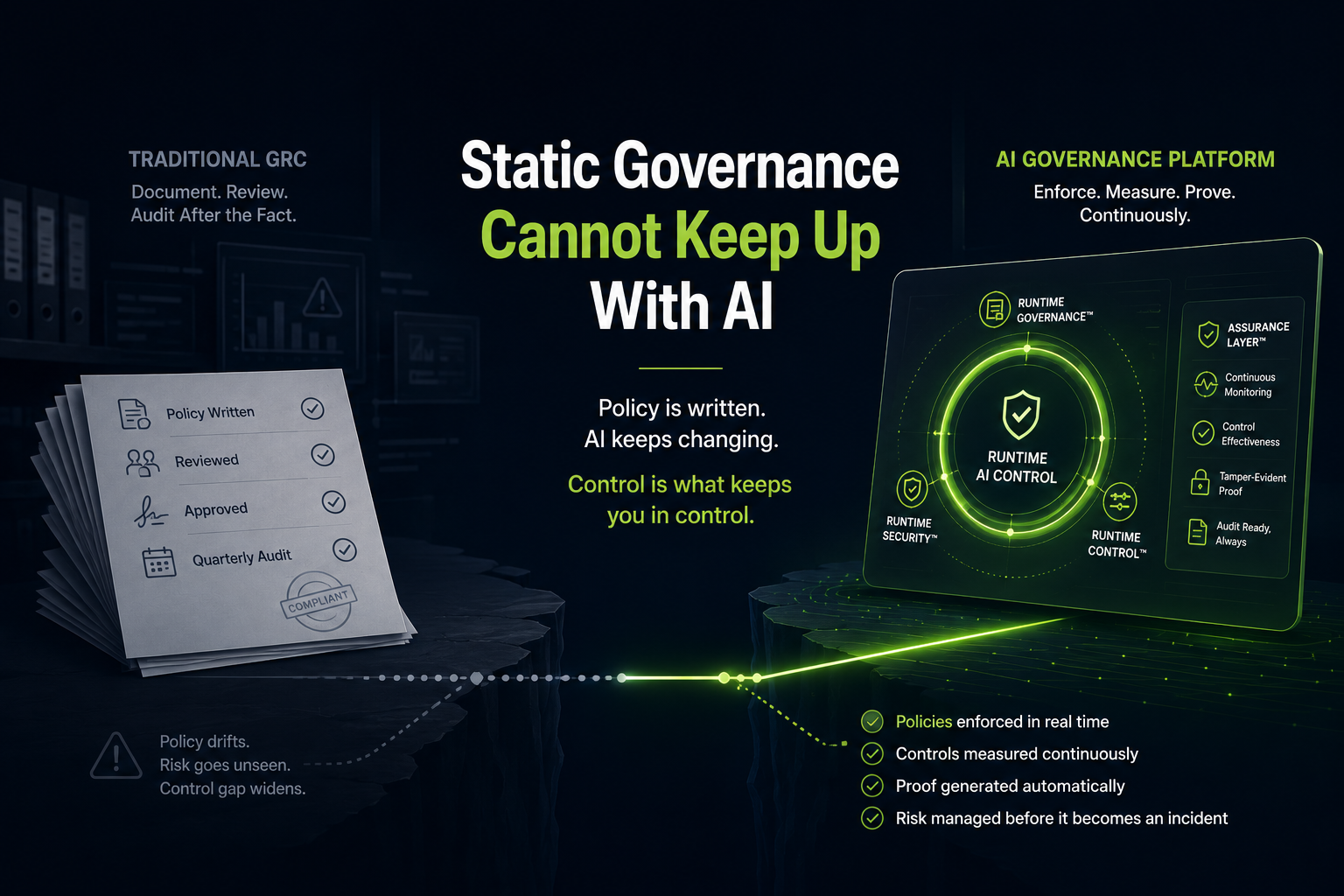
An AI governance platform operationalizes policy into live, enforceable control across AI systems, agents, and cross-system interactions. Traditional GRC software does something narrower: it documents that policy and audits it after the fact. That gap matters, because AI behavior changes between reviews, and static governance has no way to catch the drift while it is happening.
If you are evaluating an AI governance solution and wondering whether your existing GRC stack already covers it, this is the distinction that should drive the decision.
An AI governance platform is software that turns AI policy into enforceable, measurable control across the full AI lifecycle. It defines what AI systems and agents are allowed to do, enforces those boundaries in real time, measures whether the controls are actually working, and generates proof that they held.
That is a different job from AI risk management as most GRC tools define it. A governance record that says "reviewed and approved" describes a decision made on a certain day. An AI governance platform describes what is true right now, across every model, prompt, dataset, account, and agent in production.
Governance, risk, and compliance platforms were built to govern things that hold still. Risk registers, control libraries, attestation workflows, third-party risk questionnaires: all of it assumes the governed system can be documented, reviewed, and signed off, then trusted until the next cycle.
AI does not hold still. An AI system's behavior is a product of its configuration, permissions, reachable data, and the prompts and agents acting on it, and every one of those shifts between quarterly reviews. A permission that made sense in March becomes a data exposure in June. Your GRC record still reads "approved." The map and the territory have quietly drifted apart, and static governance is not built to notice.
This is why treating AI data governance as another checkbox in the same old GRC workflow leaves a blind spot. The workflow captures intent. It does not validate that intent before production, and it cannot enforce it at runtime.
Most enterprises follow the same sequence. Define AI policies. Map them to systems. Deploy controls. Rely on security to catch failures. What almost no one measures is whether those controls are consistently enforcing the original intent across live environments.
That unmeasured space is the control gap. AI rarely fails because it is malicious. It fails because controls drift, and no static governance process was designed to catch drift in real time.
Governance that cannot enforce is documentation. The control gap is the distance between your AI policy and what your AI systems are actually doing.
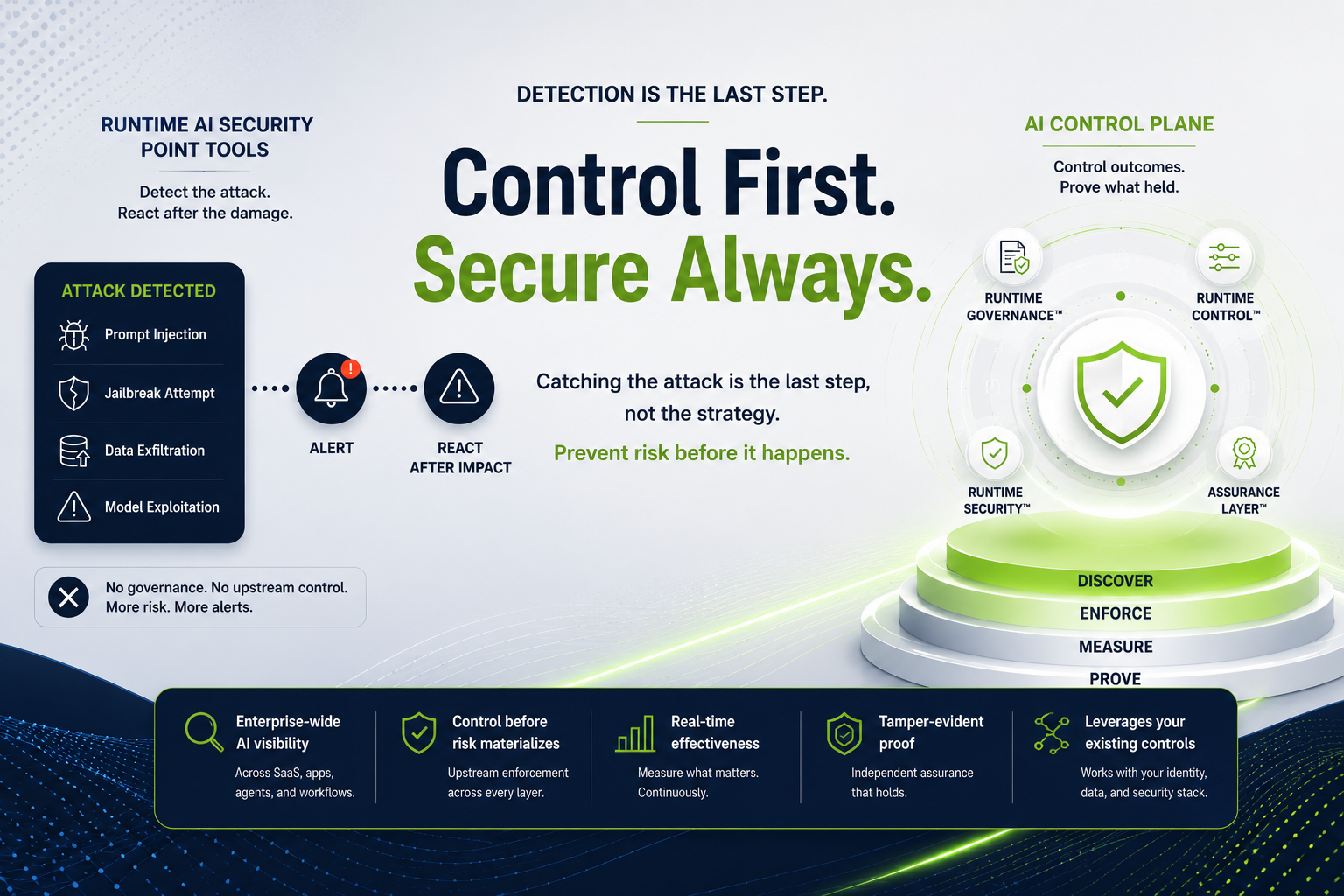
Singulr is the enterprise AI and agentic control plane. It brings live AI context and real-time enforcement to the exact layer that GRC software leaves abstract, and it does so across three tightly integrated pillars plus an independent proof layer.
Singulr Runtime Governance™ turns policy into enforceable intent, mapping ownership, risk thresholds, and rules to live systems and agents, and validating that intent before it reaches production rather than auditing it long after.
Singulr Runtime Control™ is where intent becomes real. It enforces boundaries at execution time, at the service, model, prompt, data, account, and agent levels, and it measures whether controls are working rather than assuming they are because someone configured them.
Singulr Runtime Security™ then focuses on true adversarial behavior, so security acts on high-confidence risk instead of noise.
Around all three, the Singulr Assurance™ Layer generates longitudinal, tamper-evident proof that controls operated as intended, continuously. This is the part no assessment-driven governance tool delivers: not a report you assemble for an audit, but independent proof, always current, that governance actually held.
The direction of regulation makes the case on its own. The NIST AI Risk Management Framework is organized around four functions, Govern, Map, Measure, and Manage, applied continuously across the AI lifecycle rather than at a single point. Static governance handles Govern and Map reasonably well. It struggles with Measure and Manage, which are exactly the runtime, is-it-still-working questions.
The EU AI Act, Article 72 goes further. It requires providers of high-risk AI systems to run a post-market monitoring system that actively and systematically collects and analyzes performance data throughout a system's lifetime, and evaluates continuous compliance, not a one-time conformity check. Those high-risk obligations take effect on August 2, 2026. Passive records that sit unread do not satisfy the requirement.
The pattern in both is the same one that policy-as-code brought to cloud infrastructure: governance that is enforced and verified, not just written down. An AI governance platform extends that discipline natively to AI and agentic systems.
None of this asks you to abandon your GRC investment. Your GRC platform stays the system of record for enterprise risk. An AI governance platform is the layer that makes AI governance enforceable and measurable underneath it, and it feeds real enforcement proof back into your risk records so your posture reflects production reality instead of the last form someone filled in.
The governing question has changed. It used to be "do we have an AI policy." That is now trivial to answer and protects no one. The question that matters is whether you can prove, on any given day, that the policy held across every AI system and agent you run. Static governance cannot answer that. A living control system can.
GRC documents policy, risk, and compliance and reviews them periodically. AI governance, done properly, enforces that policy in real time across live AI systems and agents and proves it held. GRC answers "did we approve this." AI governance answers "is it still true right now."
It can document AI policy and track AI as a risk, but most GRC software cannot validate intent before deployment or enforce controls at runtime. That leaves the control gap, the space between written policy and live behavior, uncovered.
The control gap is the widening distance between what your AI policy says should happen and what your AI systems actually do in production. It appears because controls drift as configurations, permissions, and data access change between reviews.
No. It complements GRC by adding runtime enforcement, continuous measurement, and independent proof for AI, then feeds that evidence back into your GRC system of record.
If you want to see the difference between documenting AI governance and proving it, book a demo with our team. We will map your AI surface, show you where the control gap is hiding, and show you how it closes.
We Put You In Control Of AI.
Read more on how Singulr compares to AI risk assessment and red teaming tools, to fragmented AI security suites, and to Runtime AI threat detection point tools.

Complete visibility across all three AI vectors in your environment, including agents and embedded SaaS AI

Singulr Pulse™ intelligence and the live risk signals that feed your control plane

Continuous red teaming, identifying control gaps and vulnerabilities in real time

Singulr Runtime Control™ enforcing governance intent without slowing innovation

.webp)