July 10, 2026
5 Min Read
AI Security Software vs a Unified AI Control Plane: The Fragmented Ecosystem Problem

Anjali Chauhan
Marketing Director

Most enterprise AI security software today is a set of AI features bolted onto tools built for other jobs. The endpoint product gets an AI module, the data protection tool gets one, the cloud posture product gets one. On paper, it looks like coverage. In practice, it is a fragmented ecosystem of detectors that were never designed to work as a single system, and fragmentation is a control problem, not a coverage problem.
If you are comparing what an AI security company offers against what a unified AI control plane does, the difference comes down to one question: can anything in your stack actually enforce your governance intent across the whole AI surface, or can it only tell you, tool by tool, that something fired?
When AI signals are scattered across half a dozen products that do not share a governance-native vocabulary, no single system can answer the only question that matters: was this AI interaction within its approved boundaries? Each tool reports whether its own detector triggered. None of them can confirm that the right thing happened.
Your real AI surface spans sanctioned SaaS AI, embedded AI features within software you already own, in-house applications, browser extensions, employee accounts, and agents that chain across several systems to complete a single task. AI application security tools tend to see the slice they were built to see. The connective tissue between them, the agentic workflow crossing three systems, is exactly where control fails and exactly what a fragmented set of features cannot watch, because no single product owns the full path.
This is also where security systems integration and cloud security integration promises break down. Integrating consoles is not the same as unifying control. You can pipe five AI detectors into one place and still have no authority to enforce a boundary before an incident occurs.
Because none of these tools enforce governance upstream, security inherits every AI problem by default. A misconfigured agent permission is not treated as a security incident until it becomes one, and by then your team is cleaning up a governance failure using detection-and-response tooling that was never meant for the job.
Security stops being precise and becomes compensatory. It gets loud, it runs behind, and it burns your most experienced people on preventable failures that a governed system would have stopped before anyone was paged.
AI threat intelligence tells you what happened. It does not ensure the right thing happened. A control plane does both, in that order.
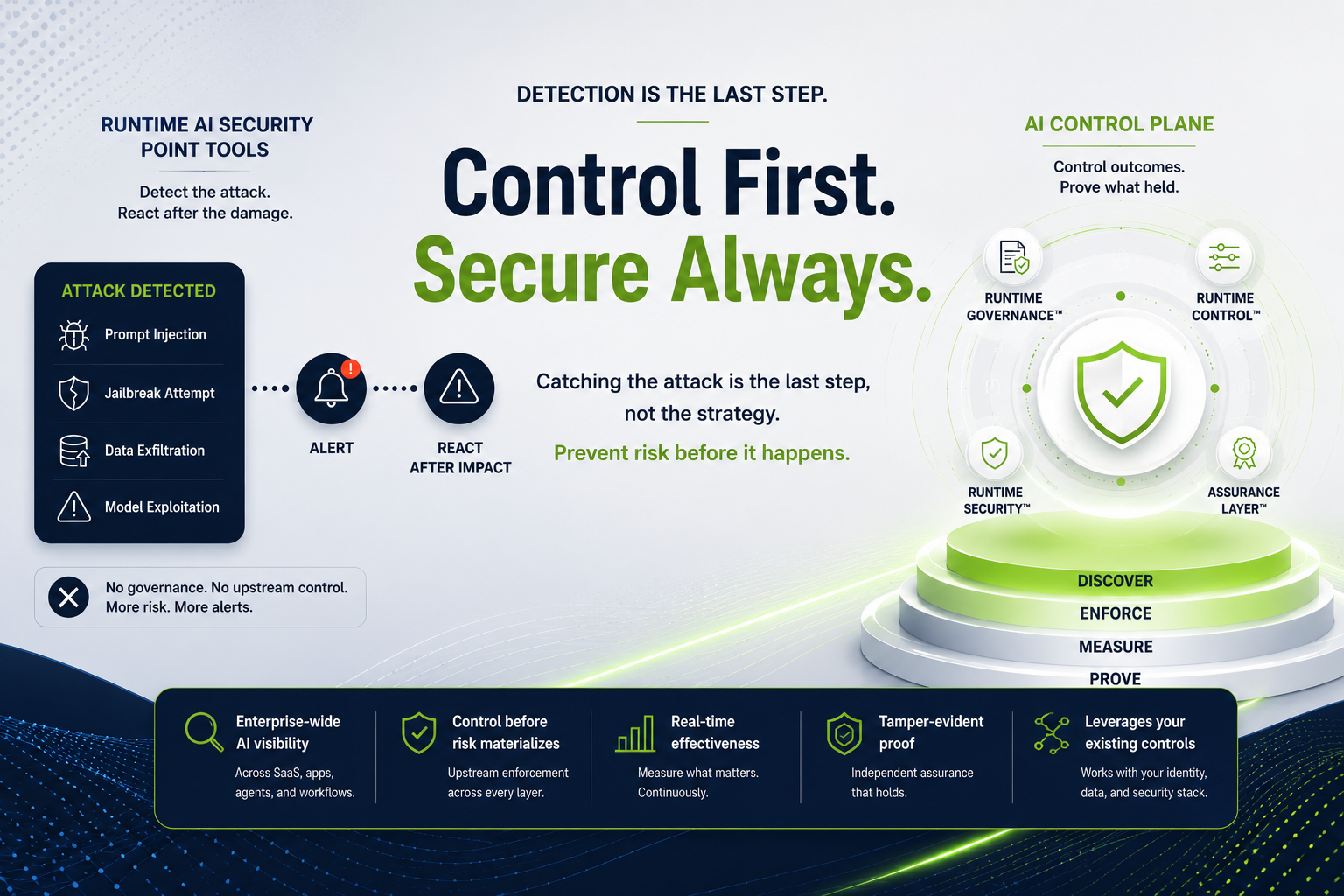
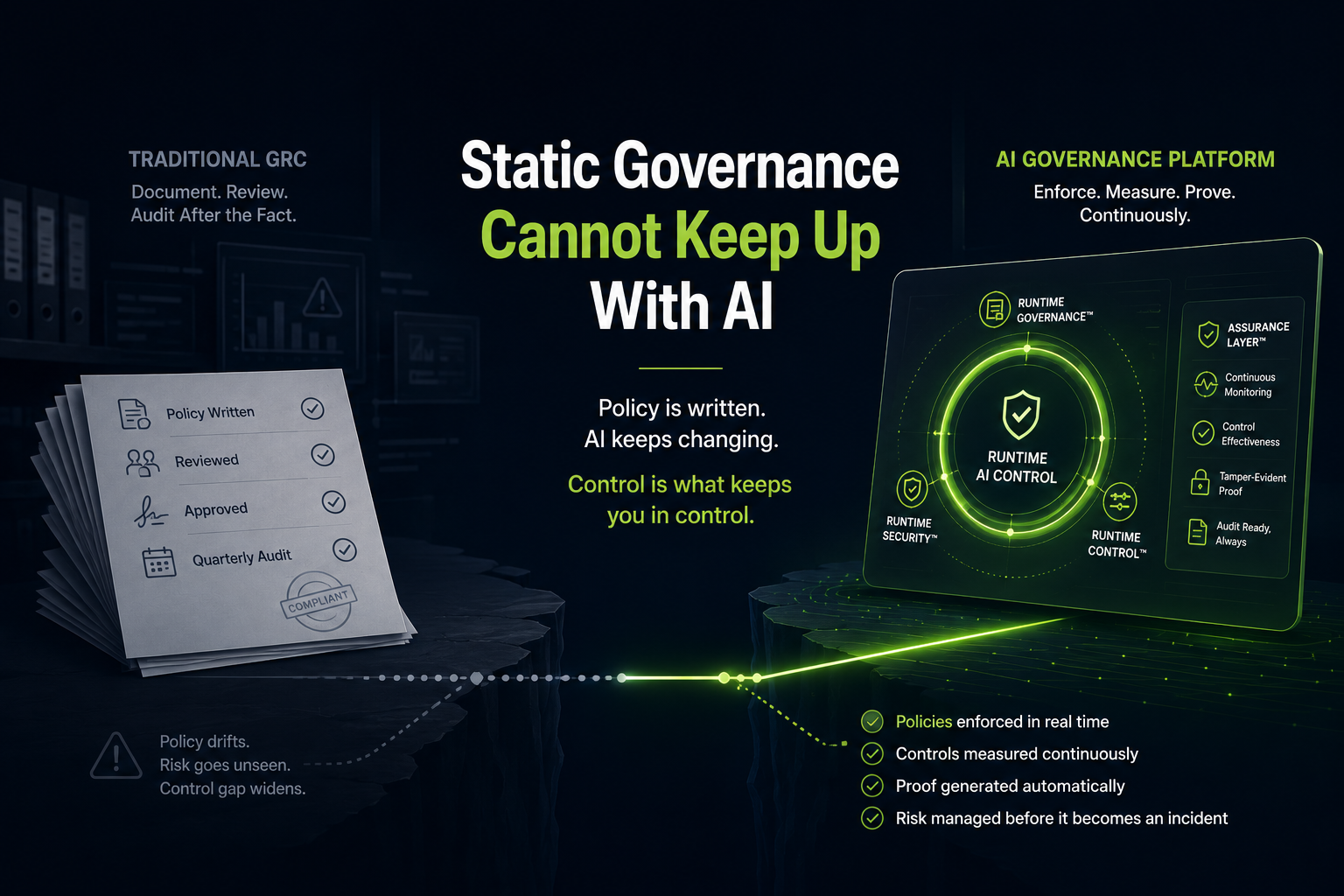
Singulr is the enterprise AI and agentic control plane. It correlates the signals a fragmented ecosystem scatters and unifies visibility and control into a single model, with a deliberate ordering that most security expansions get backward: control is the center, security is the edge.
Singulr Pulse™ is the real-time risk intelligence engine underneath that model. Instead of a dozen disconnected detectors, each holding a fragment of context, Pulse feeds a single control system with live behavioral, vendor, and environmental signals, so decisions are made with the whole picture.
Singulr Runtime Control™ enforces governance intent at execution time across systems, clouds, SaaS platforms, and agentic workflows. Boundaries hold before an incident, not after. That is the shift from a safety net to a control system.
Singulr Runtime Governance™ defines the enforceable intent that those controls carry, maps it to live systems and agents, and validates it before production.
Singulr Runtime Security™ then does what security is genuinely good at: confronting real adversarial behavior. Informed by control-plane signals and red team findings, it acts on high-confidence risk rather than noise, resulting in fewer preventable escalations and a shorter time to containment.
Surrounding all of it, the Singulr Assurance™ Layer produces longitudinal, tamper-evident proof that controls are held across the entire surface, generated continuously rather than reassembled from disconnected alerts.
Regulation is raising the bar on exactly the thing fragmented security misses: coordinated, provable response. Under the EU AI Act, Article 73, providers of high-risk AI systems must report serious incidents to authorities within tight windows: 15 days by default, 2 days for widespread or severe incidents, and 10 days where a death is involved. If your incident path runs through five tools that do not talk to each other, meeting those windows with a defensible account of what happened is a scramble every time.
The NIST AI Risk Management Framework frames the same need through its Manage function: risk has to be handled as a coordinated, cross-functional process, not a pile of point alerts. Unified control is what makes that practical.
Security suites are built to respond to incidents, and that will always have value. But responding to AI incidents and governing AI are two different disciplines, and stacking more AI features onto a response platform does not turn one into the other. Security is consequence management. Control is systemic management. A fragmented set of AI features gives you more alerts. A control plane gives you fewer incidents worth alerting on.
AI security software detects and responds to threats against AI systems, such as prompt injection, jailbreaks, and data exfiltration. Most of it is added to existing security products, so it inspects a slice of the AI surface rather than governing the whole thing.
Because scattered detectors cannot enforce governance or confirm that an interaction stayed within approved boundaries. They report what was fired, tool by tool, which leaves the security team acting as the safety net for governance failures that were never prevented upstream.
No. A security product responds to incidents at the edge. A control plane sits at the center, enforcing governance intent across every AI system and agent before incidents occur, then hands genuine adversarial risk to security with high confidence.
Yes. Unified control produces coordinated, provable enforcement and evidence, which support the continuous management the NIST AI RMF describes and the incident-reporting discipline the EU AI Act requires.
If your AI security story today is five features that each see part of the picture, book a demo. We will map your full AI surface, show you where the fragments leave you exposed, and show you what unified control looks like when the signals finally speak the same language.
We Put You In Control Of AI.
Read more on how Singulr compares to traditional GRC and AI governance platforms, to AI risk assessment and red teaming tools, and to Runtime AI threat detection point tools.

Complete visibility across all three AI vectors in your environment, including agents and embedded SaaS AI

Singulr Pulse™ intelligence and the live risk signals that feed your control plane

Continuous red teaming, identifying control gaps and vulnerabilities in real time

Singulr Runtime Control™ enforcing governance intent without slowing innovation

.webp)