Where governance meets reality

We enforce governance intent at execution time, ensuring policies are upheld across AI interactions and agentic workflows. Unlike vendors that assume controls are working, Singulr proves they are.
Measure whether controls are working, not just whether they're configured.

Across all agentic platforms and agent frameworks

The
Configuration Trap

Most enterprises assume controls are working because they're configured. That assumption breaks the moment you check.
Controls drift. Agent permissions accumulate. Configurations that made sense in March don't make sense in October. Policy lives in one system, enforcement lives in another, and nobody can prove they agree.
This is where AI fails. Not from malice. From the gap between what was supposed to happen and what did.

How It Works

Real-time enforcement.

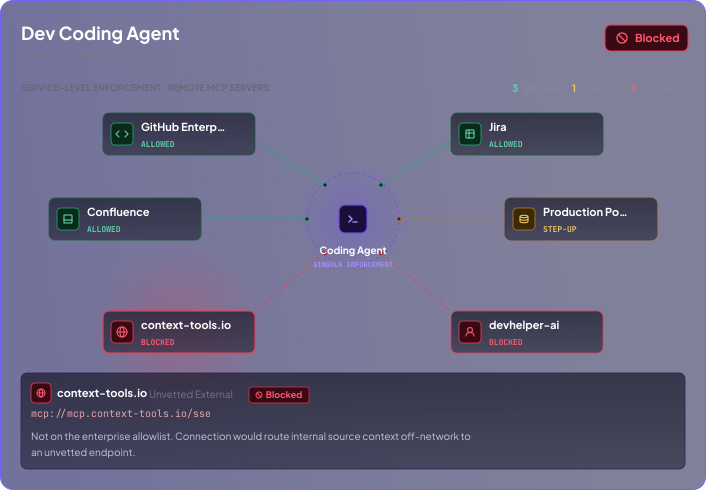
Service-level blocking of unapproved AI tools. Domain-level controls. Account-level enforcement distinguishes personal accounts from enterprise accounts. File upload blocking. PII and PHI detection and redaction, with custom sensitive-data classifiers.

Agentic boundary enforcement.

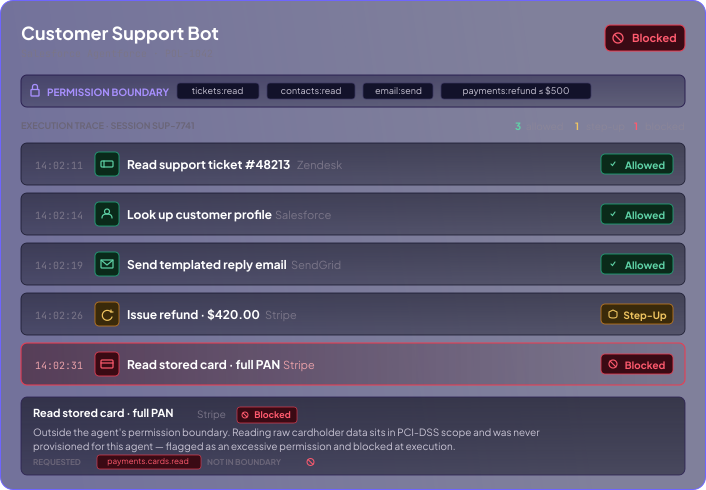
Agent permission boundaries are enforced at execution. Identification of excessive agent permissions before they're exploited. Step up enforcement when an interaction crosses into higher-risk territory.

Topology and lineage.

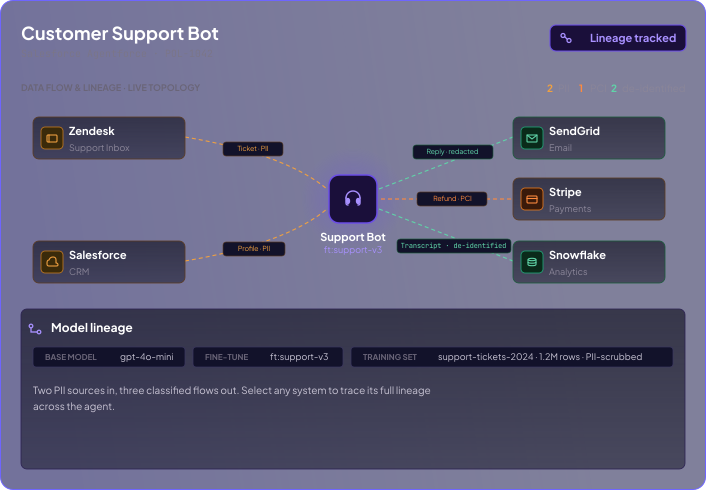
Application and AI service topology mapping. Model lineage, dataset metadata, and data flow tracking across systems.

Pre-deployment assessment.

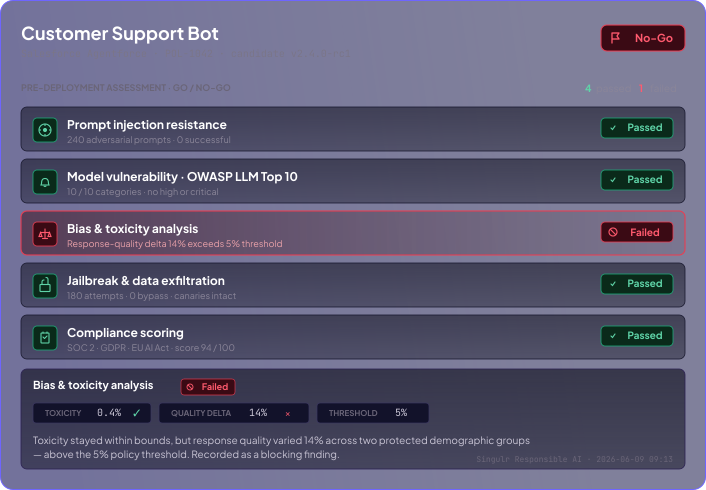
Prompt injection controls. Model vulnerability assessment. Bias and toxicity analysis. Go/no-go deployment decisions backed by evidence.
Real-time enforcement.
Service-level blocking of unapproved AI tools. Domain-level controls. Account-level enforcement distinguishes personal accounts from enterprise accounts. File upload blocking. PII and PHI detection and redaction, with custom sensitive-data classifiers.
Agentic boundary enforcement.
Agent permission boundaries are enforced at execution. Identification of excessive agent permissions before they're exploited. Step up enforcement when an interaction crosses into higher-risk territory.
Topology and lineage.
Application and AI service topology mapping. Model lineage, dataset metadata, and data flow tracking across systems.
Pre-deployment assessment.
Prompt injection controls. Model vulnerability assessment. Bias and toxicity analysis. Go/no-go deployment decisions backed by evidence.

What it delivers

For CISOs
Preventable escalations stop reaching your team. Security focuses on adversarial risk instead of compensating for upstream drift.
For CIOs
AI runs inside operational boundaries by default, across every cloud, SaaS tool, and agentic workflow.
For CAIOs and AI leaders
Agents that know their own limits. Innovation that doesn't quietly accumulate exposure.
/ LET’s COLLABORATE

See it in context

Runtime Control is one of three runtime pillars in the Singulr platform, encircled by the Singulr Assurance™ Layer.
Runtime Control is where intent becomes enforcement, and enforcement becomes proof. That’s the difference between a configured system and a controlled one.
Gradient background transitioning from deep purple to a lighter violet shade.