July 15, 2026
5 Min Read
Runtime AI Security Tools vs an AI Control Plane: Catching the Attack Is the Last Step, Not the Strategy

Anjali Chauhan
Marketing Director

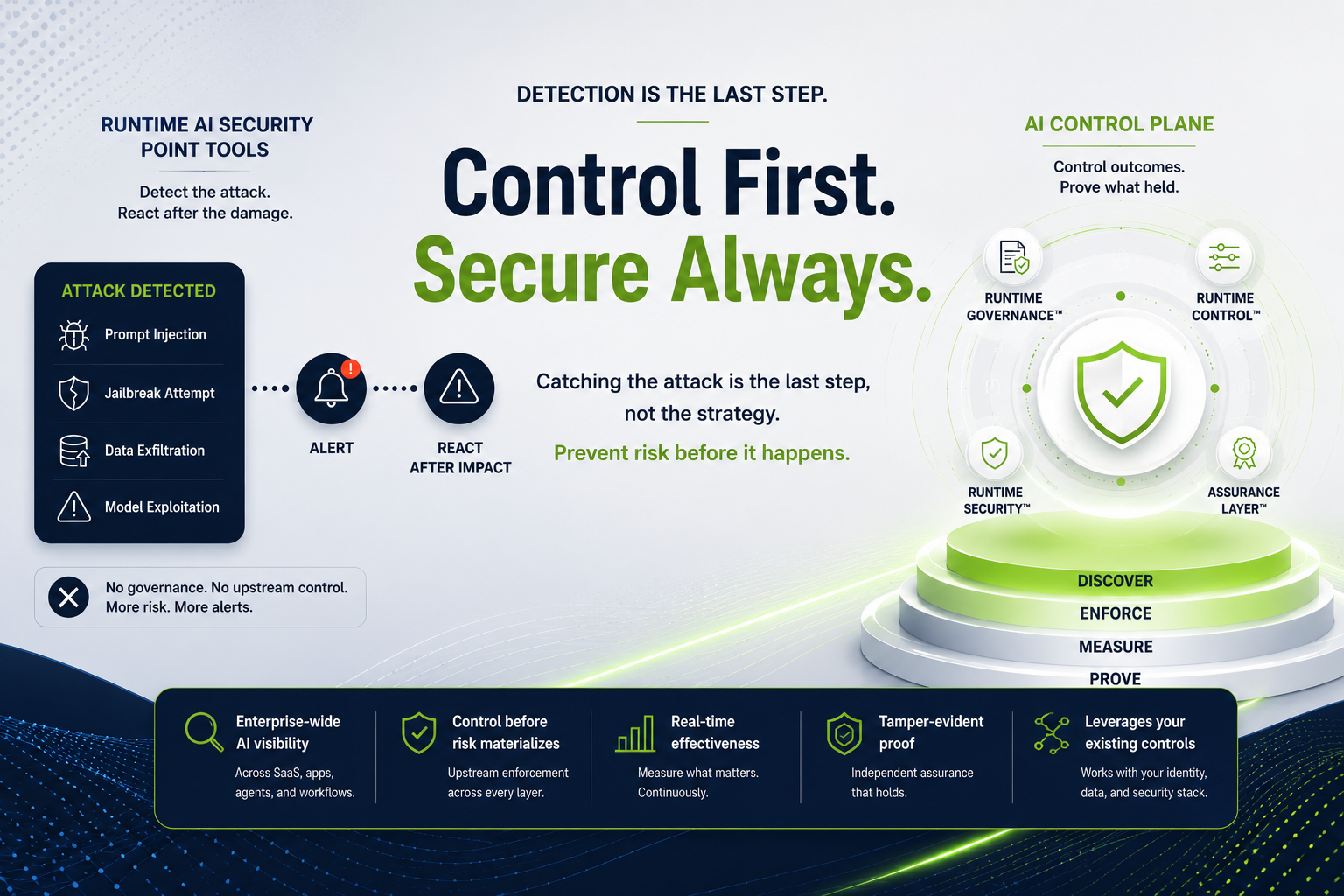
A runtime security tool for AI detects attacks in real time: prompt injection, jailbreaks, model exploitation, and data exfiltration attempts. That is real, valuable work. But detection is the last step in a long chain of decisions that determine whether the attack was ever possible, and a strategy that starts at the last step has already conceded most of the ground.
If you are comparing AI-powered threat detection point tools against an AI control plane, the useful question is not "how good is the detection?" It is "what decided the outcome before detection ever ran?"
The newest wave of AI security startups is sharp at one thing: spotting adversarial behavior against AI systems in real time. AI-based threat detection for prompt injection and jailbreaks, agentic AI threat detection across tool calls, alerts on model vulnerabilities. If something malicious is happening to your model right now, these tools are built to see it.
Keep that value in view. The argument here is not that detection is unnecessary. It is that detection alone is not control, and buying a point tool as if it were control leaves most of the problem untouched.
No governance value. These tools start at the attack. They have nothing to say about whether the AI system should have been configured that way, whether the agent should have held that permission, or whether that data should have been reachable at all. They defend a posture they never helped set. Detection without governance is another safety net, and the enterprise already has too many of those.
They do not leverage the controls you already run. Rather than connecting to your existing identity, data classification, and enforcement context, a point product adds a parallel enforcement point of its own. More tooling, less coherence, another console watching one more slice.
Point solution, not enterprise-wide. These tools cover a corner: one model gateway, one application, one narrow path. Your AI surface is far wider, spanning SaaS AI, embedded AI, in-house apps, browser extensions, employee accounts, and agents that cross several systems. A point tool illuminates its corner and leaves the rest dark, which is hard to defend when the dark part is where agentic workflows run.
Deployment friction. Many of these products insert as a proxy or agent directly in the path, which means network changes, added latency, and a rollout that fights you at every team boundary. That friction is often the real reason coverage stays partial forever: the hard-to-instrument systems never get instrumented.
A point tool tells you that an attack happened. A control plane ensures the right thing happened in the first place across every system and proves it did.
Singulr is the enterprise AI and agentic control plane, built on the opposite assumptions.
It is enterprise-wide by design rather than by roadmap, discovering and governing across the full surface: SaaS AI, embedded AI, in-house apps, agents, and the workflows that stitch them together. It is a platform, not a point. And it inserts cleanly, so coverage does not stall on the hardest-to-reach systems. Live context comes from Singulr Pulse™, the real-time risk intelligence engine feeding the control system with behavioral, vendor, and environmental signals.
More important than breadth is the ordering. Singulr leads with control, not detection.
Singulr Runtime Governance™ establishes enforceable intent, maps ownership, risk thresholds, and rules to live systems and agents, and validates that intent before production.
Singulr Runtime Control™ enforces that intent across the entire surface and works with the controls and context you already have rather than duplicating them, enforcing at the service, model, prompt, data, account, and agent levels and measuring whether controls hold.
Singulr Runtime Security™ then handles what is genuinely adversarial, with high confidence, because the noise was prevented upstream. When security acts, it acts on real risk rather than the preventable churn that a detection-only tool would escalate.
Around all of it, the Singulr Assurance™ Layer generates longitudinal, tamper-evident proof that the whole system is held across every system, continuously.
Regulation reinforces why detection alone is not a strategy. Under the EU AI Act, Article 73, serious incidents in high-risk AI systems must be reported within tight windows, as little as two days for severe or widespread cases. Fewer preventable incidents are not just cleaner security; they are less regulatory exposure. And the NIST AI Risk Management Framework puts Govern and Map ahead of the reactive functions for the same reason: what you decide upstream shapes everything detection has to deal with downstream.
Detection belongs at the edge, aimed at true adversaries, as the last line rather than the whole plan. Everything upstream of it, the configuration, the permissions, the data access, the agentic behavior, is governance and control, and that is where the outcome is actually decided.
It is software that detects and responds to attacks against AI systems in real time, such as prompt injection, jailbreaks, and data exfiltration. It focuses on the attack itself rather than on the governance and configuration decisions that made the attack possible.
No. Threat detection is important at the edge, but it starts at the attack and does not govern the upstream decisions, permissions, and configurations that determine risk. Without control-first governance, detection becomes another safety net the security team has to staff.
Threat detection tells you that an attack happened. An AI control plane enforces governance intent across the entire AI surface so the right thing happens in the first place, leverages your existing controls, and proves it was upheld. Detection is the edge; control is the center.
Proxy or agent-based tools that sit in the path add latency and require network changes, which slow rollout and leave hard-to-instrument systems uncovered. Frictionless insertion is what makes enterprise-wide coverage achievable rather than perpetually partial.
Book a demo, and we will show you your full AI surface, including the parts a point tool leaves dark, and walk through what control-first security looks like when it covers the whole enterprise rather than a single path.
We Put You In Control Of AI.
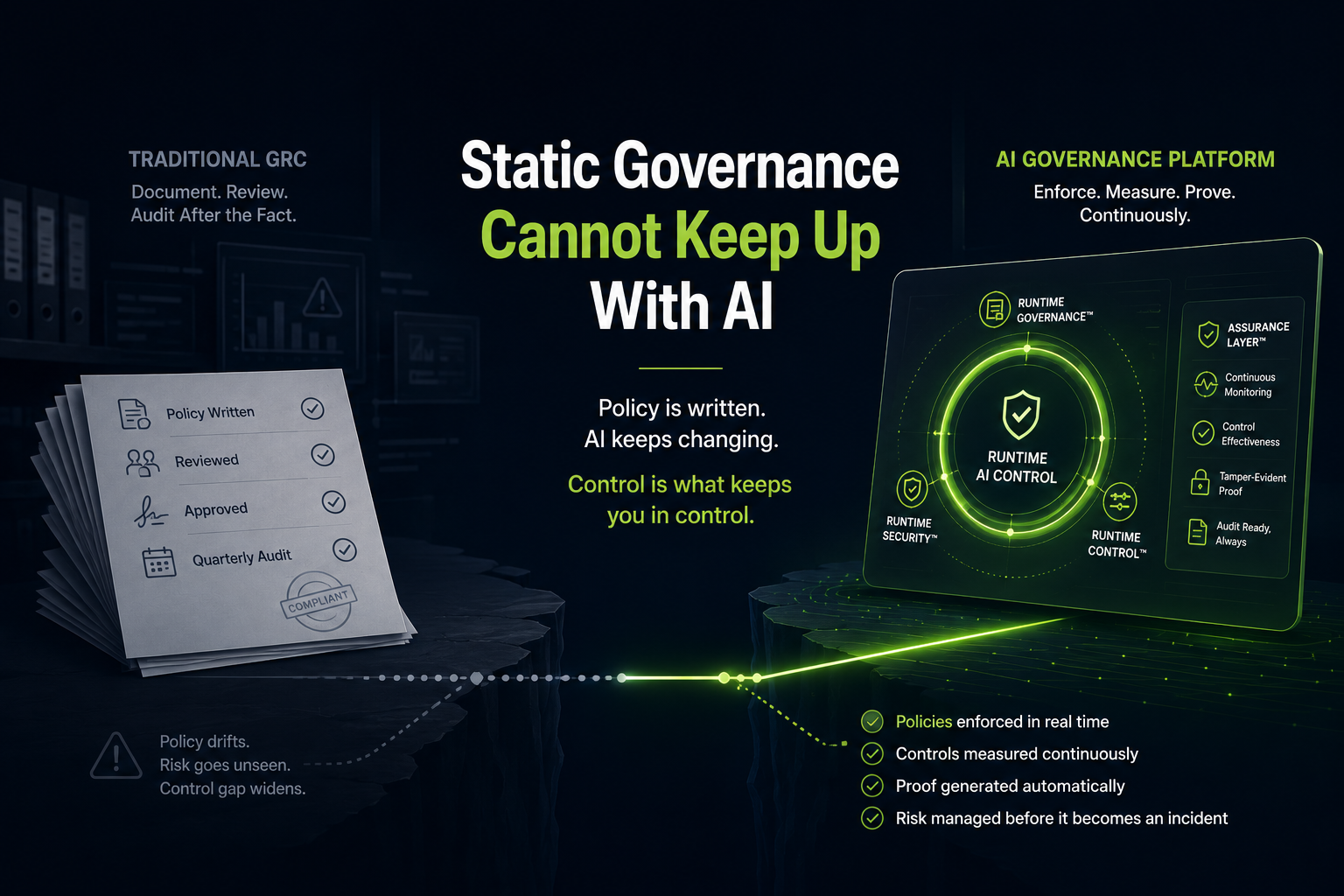
Related reading: how Singulr compares to traditional GRC and AI governance platforms, to AI risk assessment and red teaming tools, and to fragmented AI security suites.

Complete visibility across all three AI vectors in your environment, including agents and embedded SaaS AI

Singulr Pulse™ intelligence and the live risk signals that feed your control plane

Continuous red teaming, identifying control gaps and vulnerabilities in real time

Singulr Runtime Control™ enforcing governance intent without slowing innovation

.webp)