July 13, 2026
5 Min Read
AI Risk Assessment and Red Teaming vs Runtime AI Control: A Score Is Not a Control

Anjali Chauhan
Marketing Director

An AI risk assessment tells you where your AI systems stood on the day it ran. Runtime AI control determines what happens next, enforces it, and proves it held. Both matter, but they are not the same thing, and treating a risk score or a red-teaming report as if it were a control is where many AI programs quietly stall.
If you are evaluating an AI risk assessment tool, a generative AI risk assessment service, or an AI red teaming provider, this is the line worth drawing before you buy: assessment tells you about the risk, but enforcement does something about it.
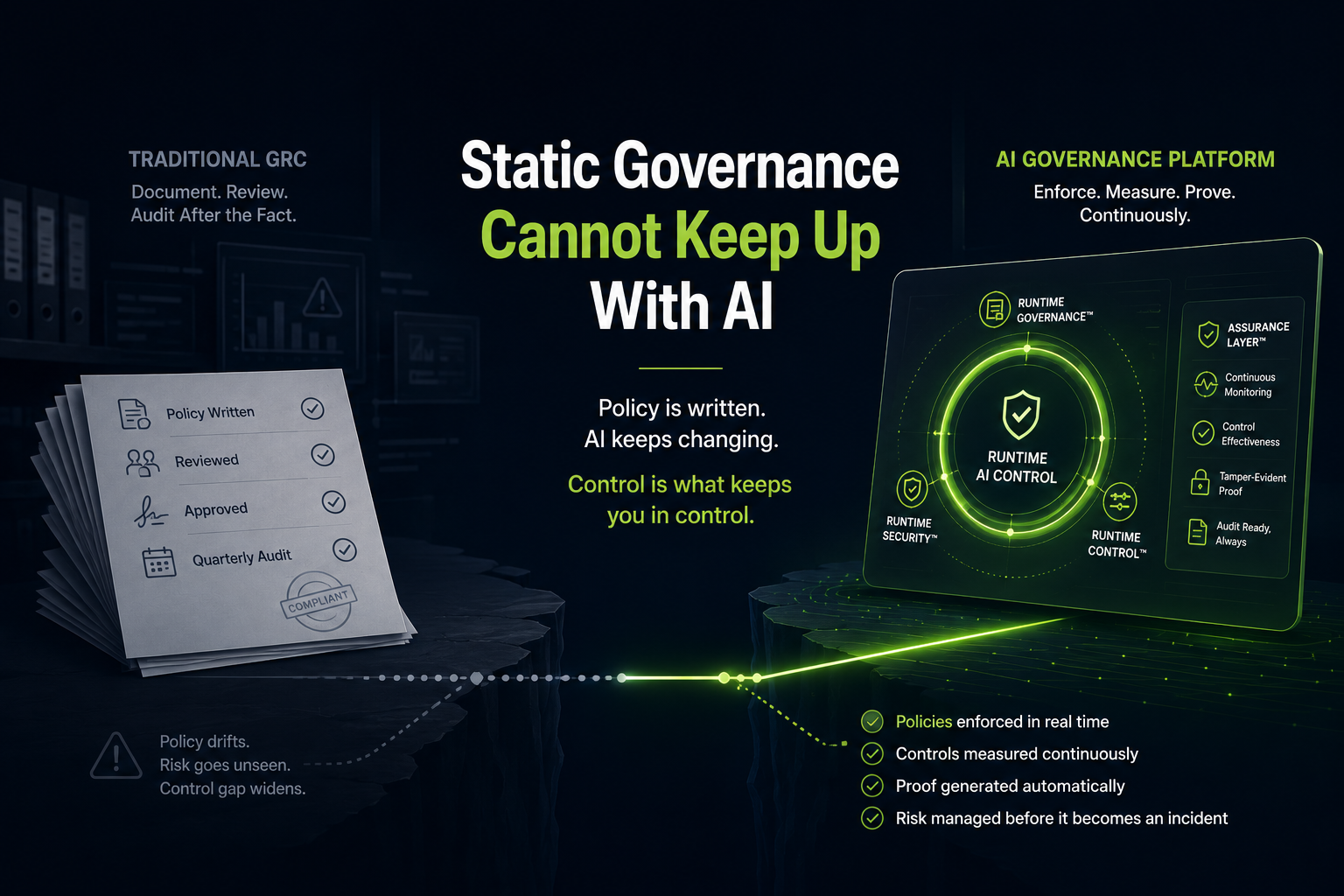
A new class of AI governance startups arrived to answer a legitimate question: Are we aligned with the rules landing on us? They map your AI use to frameworks, run a generative AI risk assessment, and hand you a posture and a score. AI red teaming tools go a step further, probing models with adversarial and jailbreak techniques to surface where they break.
This is genuinely useful work. A red teaming exercise finds real weaknesses. A risk assessment gives leadership something concrete to act on. The trouble starts when the score or the report gets mistaken for the control itself.
A narrow, point-in-time lens. Compliance is a subset of governance, not the whole of it. An assessment tells you whether you would pass today. It does not tell you whether an agent is currently operating outside its permission boundary or whether a model is accessing data it was never approved for. Those are live governance events, and a framework mapping has nothing to say about them.
No runtime enforcement. Most of these tools stop at the assessment. They produce an accurate document describing your exposure. Describing exposure is not preventing it. Governance that cannot be enforced is documentation, and documentation has never stopped a single agent from doing the thing your policy said it should not. The assessment is not wrong; it is just inert, and inert is a poor quality when the systems it describes are making decisions every second.
Built for the last generation of AI. This first wave was designed for prompt-and-response, single-model use. The enterprise has already moved to agentic systems that invoke tools, chain across services, and act autonomously. Agentic AI risk management needs a vocabulary for an agent that touches four systems in one workflow, and a tool that reasons in single model calls does not have it.
Red teaming finds the weakness. It does not keep it fixed. A control plane enforces the fix and proves it holds tomorrow.
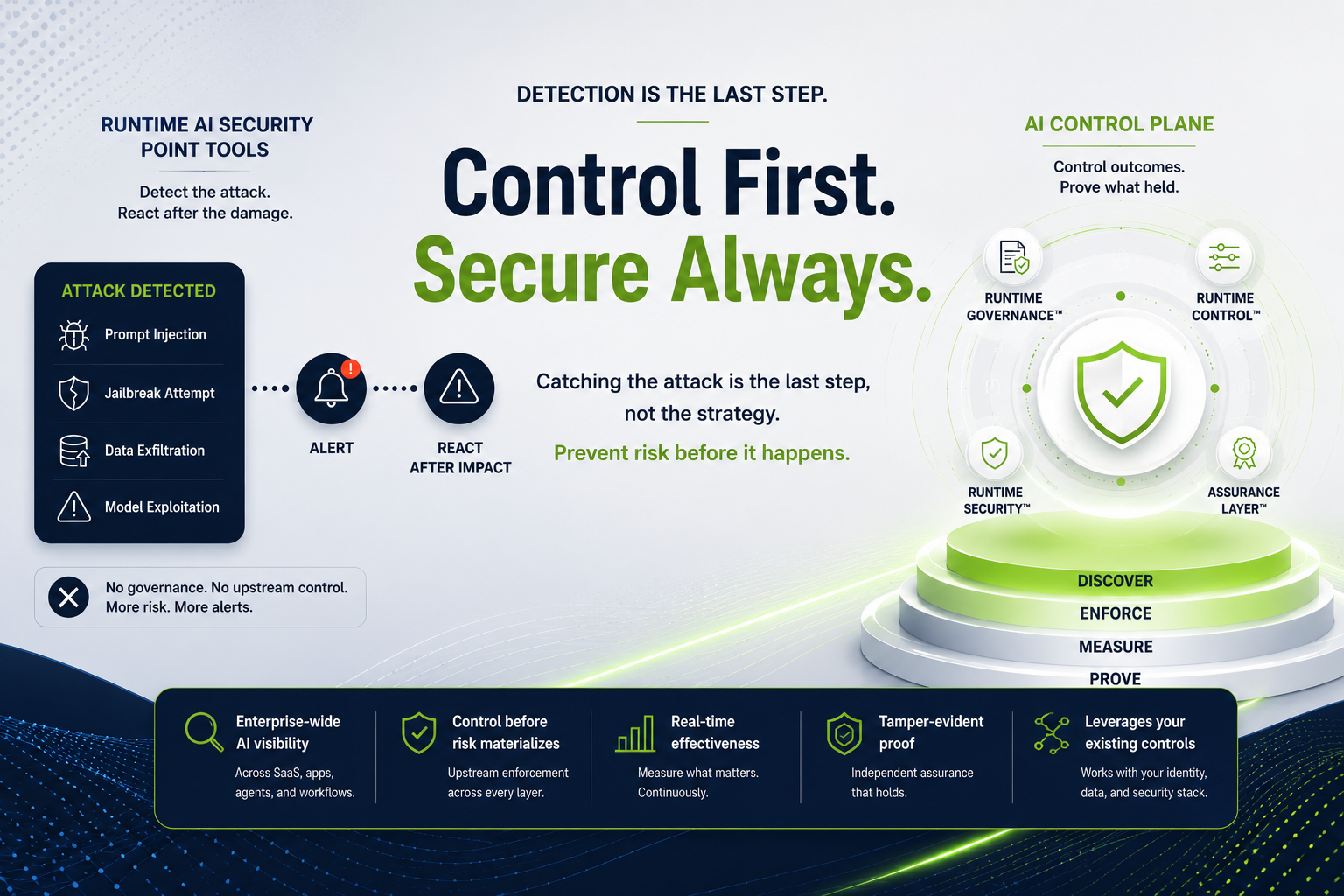
Singulr is the enterprise AI and agentic control plane. It picks up precisely where assessment-only tools leave off and closes the loop they open.
Singulr Runtime Governance™ turns policy into enforceable intent, validated before deployment and maintained continuously as systems and risks evolve. Red teaming and adversarial simulation live here as inputs that shape enforcement, not as a report that ends in a slide deck.
Singulr Runtime Control™ is the enforcement layer assessment tools lack. It is granular, applying at the service, model, prompt, data, account, and agent levels. It is contextualized, so decisions incorporate identity, department, data classification, vendor posture, region, and history rather than acting as a generic filter. And it is cross-system, spanning clouds, SaaS, internal workloads, and agentic dependencies. Crucially, it continuously measures control effectiveness, so AI risk mitigation is something you can verify, not assume.
Singulr Runtime Security™ handles genuine adversarial behavior with high confidence because the preventable noise was stopped upstream.
The Singulr Assurance™ Layer then replaces the score with something a score can never be: longitudinal, tamper-evident, independent proof, generated continuously. And the system gets smarter over time. Discovery feeds governance, behavior feeds control, failures feed security, and every outcome feeds back. That closed loop, from insight to enforcement to learning, is the moat, and it is why a control plane keeps improving while a static assessment goes stale the moment it is generated.
Assessment-only tooling also sits awkwardly against where regulation is heading. The EU AI Act, Article 72, requires providers of high-risk AI systems to actively and systematically collect and analyze performance data throughout a system's entire lifetime and to evaluate ongoing compliance. A one-time risk assessment does not meet an active, continuous obligation, and those high-risk requirements take effect on August 2, 2026.
The NIST AI Risk Management Framework makes the same point structurally: its Measure and Manage functions are ongoing rather than one-off. Runtime control is how an organization actually operationalizes them.
A compliance score tells you where you stood. A control plane determines what happens next, across every live system and agent, and proves it did. As AI moves from assistants to autonomous agents acting on your behalf, that difference stops being a nice-to-have. You cannot govern a system that acts on its own with an annual questionnaire, and you cannot enforce a boundary with a PDF.
An AI risk assessment evaluates an AI system's exposure against risks and regulatory frameworks and produces a posture or score. It is a valuable snapshot, but it describes risk rather than enforcing controls against it.
No. Red teaming surfaces weaknesses through adversarial testing, which is important, but it does not enforce the fixes or keep them in place. It works best as an input that feeds continuous runtime control, not as a standalone governance program.
Assessment tells you where you stand at a point in time. Runtime control enforces governance intent continuously across live systems and agents and proves the controls held. One measures, the other acts and verifies.
Agentic AI risk management requires enforcement at the agent and cross-system level, not just single-model assessment. It means setting enforceable boundaries on what agents can do, measuring whether those boundaries hold, and continuously proving they do.
If a report on your risk was step one, then enforcing and proving your governance in real time is the next step your enterprise needs. Book a demo, and we will show you what it looks like to move from a score you receive to a control system that acts, measures, and proves.
We Put You In Control Of AI.
Read more on how Singulr compares to traditional GRC and AI governance platforms, to fragmented AI security suites, and to Runtime AI threat detection point tools.

Complete visibility across all three AI vectors in your environment, including agents and embedded SaaS AI

Singulr Pulse™ intelligence and the live risk signals that feed your control plane

Continuous red teaming, identifying control gaps and vulnerabilities in real time

Singulr Runtime Control™ enforcing governance intent without slowing innovation

.webp)