November 13, 2026
5 Min Read
The Agent Already Acted

Anjali Chauhan
Marketing Director

In July, Goldman Sachs’s chief information officer was talking up the tools the bank’s traders and bankers had built with AI coding agents. People outside engineering were writing their own software to track client flows and model positions, then handing it to engineers to harden. By October, most of them had lost access. According to reporting from State of AI, citing Bloomberg, updated internal guidance issued after a review of productivity and risk now limits Anthropic’s Claude Code and Microsoft’s GitHub tools to Goldman’s engineers, a group of more than 12,000 out of roughly 47,000 employees.
Read quickly, the story is about access. A bank decided coding agents were too risky in the hands of people who can’t review the code those agents produce. That decision is defensible. It also leaves the bigger question untouched, and every bank and asset manager running agents will have to answer it sooner or later: What keeps an agent in bounds once it starts working?
An AI coding agent reads files, writes programs, and runs them, usually with the full access of the person who launched it. Inside a financial institution, that person’s access often spans client data, position data, and systems that compliance teams have spent years keeping apart. The agent inherits all of it. Taking agents away from some employees reduces how many people can start one. The engineers who keep access are still running the same kind of software with the same reach.
The controls a bank or asset manager depends on were written with people in mind. Agents behave differently, and the gaps show up in a handful of specific places.
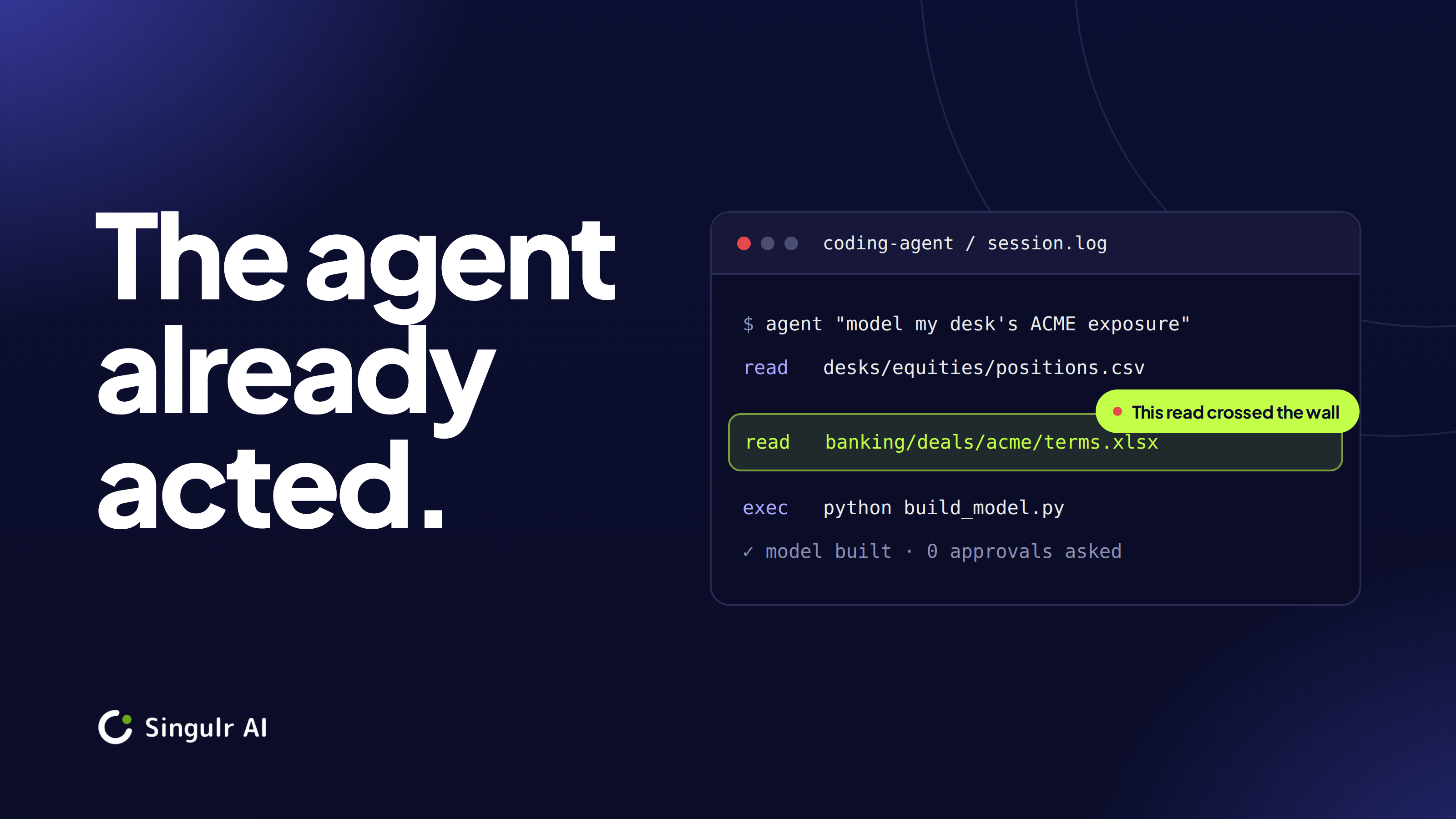
Banks separate deal teams from traders because one side could profit from what the other knows. Those barriers are held in place by entitlements and approvals, and by the plain friction of people having to ask each other for things. A coding agent never feels that friction. Ask it to model a position, and it will pull from whatever repositories and data stores its user can reach. If that reach happens to cross a barrier, nothing inside the agent notices. The barrier still exists on paper while the agent works straight through it.
Code an engineer writes with an agent typically passes through review, testing, and deployment before it gets near production data. A script a trader builds to watch client flows can skip those steps and end up in daily use, which is one of the concerns raised in the Goldman reporting. Agents widen that gap because they don’t hand back a draft for someone to approve. They execute. By the time a log shows what happened, the agent has already read the data and run the command, and a review at that point can only explain the damage.
A tool a trader builds with an agent is never designed with the firm’s controls in mind, and engineering only sees it if someone thinks to send it over. Regulators expect a firm to know who is accountable for software that touches client information. Agent-built code usually shows up with no named owner and no review history behind it.
Few of these failures will start with an attacker. Most start with something mundane: a permission that was reasonable when it was granted but quietly stopped being reasonable, an agent wired to one more tool than it needed, or an MCP server that picked up a write capability nobody reviewed. Controls get configured once and then drift away from what the business intended. Most firms treat a configured control as a working one, and very few continuously check whether that is still true.
When governance and controls fail upstream, the failure lands on the security team. The SOC ends up chasing incidents that were really permission mistakes or policy gaps, and those incidents bury the adversarial signals the team exists to catch, such as prompt injection, tool misuse, or an agent manipulated into acting outside its purpose.
Pulling the tools was a sensible first move for Goldman. Unreviewed code from people who can’t read it has no place near a trading book, and the information-barrier concern on its own would justify caution.
It still comes with costs. Traders and bankers had found legitimate uses, and the reporting doesn’t mention anything replacing that work. The agents that engineers still run carry the same capabilities as before. Much of the industry is also heading the other way. Barclays said in October that it expects half its developers to be using Claude Code by the end of the year. Agentic AI is here to stay in financial services, so the real test for each firm is whether it can show its agents are operating the way the firm approved.
Passing that test calls for a different set of capabilities than access management provides, and most firms don’t yet have them in one place.
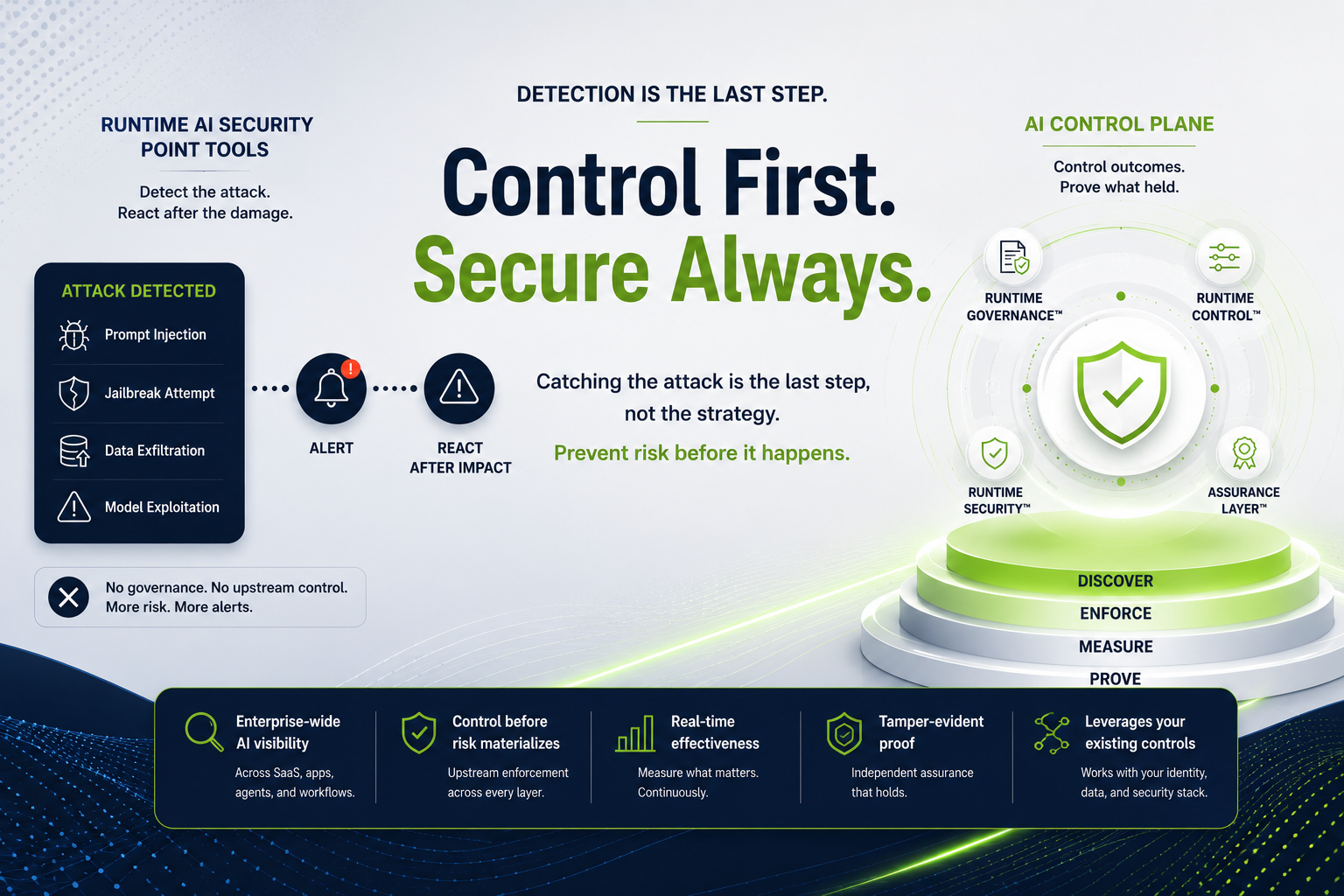
It starts with an inventory that covers agents properly. That means the agents themselves, including the ones employees set up on their own, and the MCP servers and tools they connect to, along with what each one can actually do. An agent limited to reading data carries a very different risk from one that can write, delete, or execute.
The firm’s own policy then has to become something enforceable. Information barriers, data entitlements, and acceptable-use rules need to apply at the moment an agent acts, scoped to who launched it, what data is involved, and which tool it is calling, so the boundary holds while the work is happening.
Controls also need continuous measurement. A control that was set up correctly last quarter may not hold today, so firms need to know whether enforcement is working right now and whether agent permissions and tool capabilities have drifted from what was approved.
And firms need evidence. Examiners and auditors want proof that controls held across real activity over time, something a policy document can’t provide.
Singulr is the enterprise AI and agentic control plane. One horizontal control plane across every AI system, agent, and endpoint. Not another vertical. The layer that unifies them.
Most financial institutions already have controls for pieces of this problem. Identity decides who can sign in, endpoint tools see the laptop, and each AI vendor adds settings for its own product. None of them governs what an agent does as it moves between systems, and that is where the control gap opens: the distance between the policy a firm sets and what its AI actually does at runtime.
Singulr closes that gap at the moment an agent acts. Singulr Pulse™, its real-time risk intelligence engine, discovers the AI services, MCP servers, and coding agents in use. Each one is tied to the person who launched it, using the identity context the firm already has in Okta or Microsoft Entra ID. For coding agents such as Claude Code, it enforces policy inside the session, one tool call at a time. File access stays within the scope of the project, dangerous shell commands and high-risk MCP tool parameters are blocked, and attempts to bypass permission prompts are stopped. A read that would cross a barrier is stopped before it happens instead of explained after it.
Singulr works through what the firm already runs, enforcing at the endpoint, in the browser, through native cloud integrations, and through existing security tools. Across all of it, Singulr keeps one record of AI activity: who launched each agent, what it reached for, which policy applied, and what was allowed or stopped. It flags drift from what was approved and builds longitudinal, independent proof that controls operated as intended, mapped to frameworks such as NIST AI RMF and the EU AI Act. With preventable failures stopped upstream, the security team can spend its time on real adversarial behavior, such as prompt injection, instead of cleanup.
A firm can let traders, bankers, and engineers work with agents and still show, at any point, that each agent is operating inside the boundaries the business approved.
Goldman’s traders were tracking client flows and modeling positions. That work still needs doing, and agents will be doing more of it at every bank and asset manager. The firms that get the most from agents will be the ones that can govern them closely enough to keep saying yes.
We put you in control of AI.
Reporting on Goldman Sachs referenced in this article comes from State of AI, citing Bloomberg News.

Complete visibility across all three AI vectors in your environment, including agents and embedded SaaS AI

Singulr Pulse™ intelligence and the live risk signals that feed your control plane

Continuous red teaming, identifying control gaps and vulnerabilities in real time

Singulr Runtime Control™ enforcing governance intent without slowing innovation