The Enterprise Buyer's Guide to AI TRiSM (Trust, Risk, and Security Management)
Everything you need to evaluate, compare, and select a solution that delivers all four layers of Gartner's AI TRiSM framework from a single platform, not four disconnected tools.
Most enterprises already accept Gartner's AI TRiSM framework as the standard for managing AI's trust, risk, and security challenges. Where they struggle is implementation. TRiSM defines four layers that are meant to work as one system, and most organizations end up buying a separate tool for each, then paying a coordination tax to keep them aligned.
The Scale of the Challenge Enterprises rarely fail at TRiSM because they ignore it. They fail because they implement it in fragments: one tool for governance, another for runtime enforcement, a third for data classification, and manual effort to hold the seams together. The governance platform cannot enforce policy at runtime. The runtime tool has no view of the AI catalog. Each layer operates blind to the others, and the gaps between tools are where incidents happen.
The Business Imperative Fragmented TRiSM turns AI adoption into a multi-team approval chain. Every policy change means updating several tools, retraining several teams, and hoping nothing slips through. Business units stop waiting and deploy AI without oversight. A connected TRiSM implementation reverses that. The enterprise adopts AI quickly and keeps accountability for how that AI behaves.
The question is not whether to adopt TRiSM, but how to implement all four layers without stitching point solutions together.
Defining AI TRiSM
AI TRiSM is Gartner's framework for keeping AI systems operating within acceptable boundaries across the enterprise. It spans four layers designed to reinforce one another. Together they cover AI from experimentation through production, across homegrown, public, and embedded systems, including agentic systems that act autonomously.
The Four TRiSM Layers
AI Governance: Catalog every AI asset, score its risk continuously, and enforce accountability from experimentation through production.
Runtime Inspection and Enforcement: Inspect AI models, applications, and agent interactions in real time, and stop threats as they happen.
Information Governance: Control what data AI systems can access, classify sensitive information, and enforce permissions across every AI interaction.
Infrastructure and Stack: Apply proven endpoint, network, cloud, and identity controls to AI workloads.
How a True TRiSM Platform Differs from Partial Tools
Most vendors cover one or two layers and call the result a platform. Knowing the boundaries prevents both overlapping spend and the coverage gaps that fragmentation creates.
Governance-only platforms: Define policy and manage risk processes, but cannot enforce that intent at runtime.
Runtime-only security tools: Inspect and block AI traffic, but operate blind to the AI catalog and the governance intent behind it.
Data Security Posture Management (DSPM): Classifies and protects data, but does not govern AI behavior, agent permissions, or model risk.
Per-layer point solutions: Cover a slice of TRiSM well, but leave the seams between layers uncovered, and the seams are where incidents occur.
A true TRiSM solution covers all four layers with connected enforcement, where discovery informs governance, governance informs runtime enforcement, and runtime signals feed back into risk scoring. The test is whether the layers operate as one system rather than four tools coordinated manually.
The Top 5 AI TRiSM Platforms for Enterprises in 2026
The AI TRiSM market has grown fast, and so has the number of vendors claiming to cover it. Security suite vendors, network proxy platforms, cloud-native tooling, and purpose-built control planes all position themselves as complete solutions. Most cover one or two layers well. Few deliver all four from a single system.
The platforms below represent the most commonly evaluated options in enterprise AI TRiSM decisions today. Each has a different architectural starting point, a different coverage model, and a different set of tradeoffs. The goal is to help you assess where each fits, and where it doesn't, before you run a proof of concept.
1. Singulr AI - Best for Enterprises That Need All Four TRiSM Layers From a Single Control Plane
What it is: Singulr is an Enterprise AI and Agentic Control Plane, purpose-built to deliver all four layers of the Gartner AI TRiSM framework from a single connected system. Where most vendors address TRiSM as an extension of an existing product, Singulr is built for it from the ground up.
How it covers TRiSM:
AI Governance: Singulr's Runtime Governance™ layer delivers a continuously updated catalog of all AI models, applications, agents, and datasets across the enterprise. Risk is scored automatically and continuously, not assessed by hand at intervals. Policies are authored in natural language and enforced through a single cross-functional approval workflow, from experimentation through production.
Runtime Inspection and Enforcement: Singulr's Runtime Control™ inspects every AI interaction in real time, across browser sessions, API calls, and agent actions. Enforcement actions include blocking, allowing, restricting, redacting, and rerouting to a safe alternative. Prompt injection, content policy violations, and anomalous usage are detected and acted on at the point of interaction, not flagged in a report for someone else to chase.
Information Governance: Singulr covers all three AI vectors where data exposure occurs: homegrown applications and agents, public AI tools, and AI features embedded in SaaS platforms. Data classification and access enforcement operate continuously. Sensitive data, including PII and PHI, is prevented from reaching unauthorized AI services before exposure occurs.
Infrastructure and Stack: Singulr integrates natively with existing SIEM, SOAR, SSO, and ticketing systems. Adoption does not require replacing existing infrastructure. Coverage extends consistently across cloud, hybrid, and on-premises AI environments from a single control plane.
What sets it apart: The four TRiSM layers share a single inventory and a single policy model. When a policy changes, it propagates automatically across all layers. Runtime signals feed back into risk scoring. Discovery informs governance intent before a policy is ever authored. This is what a closed-loop TRiSM implementation looks like, and it is what disconnected point solutions cannot replicate.
Who it's best for: Enterprises that have tried assembling TRiSM from multiple tools and are paying the coordination tax, or those that want to implement all four layers correctly the first time, especially as agentic AI scales across the organization.
2. Zscaler AI Security Suite - Best for Organizations Already Committed to Zscaler Zero Trust Exchange
What it is: Zscaler's AI Security Suite is an AI governance and posture module integrated into the Zero Trust Exchange platform. Launched in early 2026, it provides an AI asset inventory and dependency map across GenAI services, embedded AI SaaS, AI development environments, MCP servers, agents, models, and AI infrastructure.
How it covers TRiSM
Zscaler's strengths lie in the Infrastructure and Stack layer and portions of Runtime Inspection, where its inline inspection, prompt classification, and Zero Trust controls are most mature. The AI asset inventory addresses the discovery requirement of the Governance layer, and automated red teaming and continuous posture assessment cover elements of the Information Governance layer.
The limitation: Zscaler's architecture is built around proxy-based traffic inspection, which delivers strong coverage for AI interactions flowing through the browser or web-proxied channels. AI activity in native desktop applications, developer IDEs, and autonomous agent frameworks that don't consistently route through a web proxy falls outside that visibility model. Organizations with a broad AI footprint across all three vectors will find coverage gaps in those surfaces.
Who it's best for: Enterprises already standardized on the Zscaler Zero Trust Exchange, where AI governance becomes an extension of existing infrastructure rather than a new vendor relationship.
Considerations: AI governance is not a Zscaler standalone product. Buyers not already in the Zscaler ecosystem face a broader platform adoption decision before they can access these capabilities.
3. Palo Alto Networks Prisma AIRS - Best for Security-First Organizations Governing Custom AI Development
What it is: Prisma AIRS is Palo Alto Networks' AI security platform that covers AI model security, posture management, red teaming, runtime security, and AI agent security. In 2026, Prisma AIRS 3.0 added agentic AI discovery and protection, and the acquisitions of Protect AI, Koi, and Portkey expanded its model scanning, agentic endpoint security, and AI gateway coverage.
How it covers TRiSM
Prisma AIRS addresses the Runtime Inspection layer most comprehensively, with strong model scanning, automated red teaming, runtime prompt inspection, and agent security. Its posture management capabilities address the Governance layer for development-centric AI teams, and infrastructure integration connects to Prisma Cloud for code-to-cloud coverage.
The limitation: Prisma AIRS is most mature for organizations building and deploying custom AI models and agents. Enterprises whose TRiSM challenge centers on governing employee AI adoption and shadow AI across public tools and embedded SaaS features will find the platform's strengths weighted toward the development and infrastructure side of the framework rather than the information governance and workforce AI control side.
Who it's best for: Enterprises with significant AI development programs that need lifecycle security from model scanning through runtime protection, especially those already in the Palo Alto Networks ecosystem.
Considerations: Prisma AIRS is part of the broader Palo Alto platform, not a standalone product. Organizations not already in that ecosystem face a broader adoption decision before accessing these capabilities.
4. Microsoft Purview (DSPM for AI + Defender for Cloud AI-SPM) - Best for Microsoft-Centric Organizations Governing Copilot and Azure AI
What it is: Microsoft's TRiSM-relevant capabilities span two products: Microsoft Purview DSPM for AI, which handles data security posture management, compliance controls, and AI observability within the Microsoft 365 and Azure ecosystem; and Microsoft Defender for Cloud AI-SPM, which maps AI workloads across Azure OpenAI, Copilot Studio, and custom agent frameworks with misconfiguration detection and threat alerts.
How it covers TRiSM
Microsoft's coverage is strongest within the Information Governance and Infrastructure layers for organizations whose AI footprint is primarily Microsoft 365 Copilot, Azure AI services, and Entra-registered applications. Purview's DLP integration, sensitivity labeling, compliance mapping, and audit capabilities deliver mature governance tooling for that environment.
The limitation: Microsoft's AI governance coverage is architecturally bounded by the Microsoft ecosystem. AI services outside that boundary, public AI tools accessed outside Edge, non-Entra-registered applications, third-party SaaS AI features, and agentic frameworks not built on Azure require partner integrations to surface in the posture picture. For enterprises whose AI footprint has expanded beyond the Microsoft stack, that creates the same three-vector visibility gap that any cloud-native AI security control introduces.
Who it's best for: Microsoft-centric organizations, particularly those heavily invested in Microsoft 365 Copilot and Azure AI, where Purview's compliance integration and native Copilot governance justify the existing licensing footprint.
Considerations: Non-Microsoft AI activity requires supplemental tooling. Organizations expecting cross-ecosystem AI governance from Purview alone should map coverage gaps carefully before assuming completeness.
5. CrowdStrike Falcon (AI-SPM + AI Detection and Response) - Best for Security Operations Teams Extending Endpoint Governance Into AI
What it is: CrowdStrike's AI security capabilities are delivered through Falcon Cloud Security's AI-SPM module and the AI Detection and Response (AIDR) capability announced at RSAC 2026. Together, they provide shadow AI discovery via endpoint DNS telemetry, visibility into AI services and agents across cloud environments, prompt interception and policy enforcement, and AI agent discovery integrated with platforms including Microsoft Copilot Studio, Salesforce Agentforce, and ChatGPT Enterprise.
How it covers TRiSM
CrowdStrike's strength is in the Runtime Inspection layer and portions of Governance and Infrastructure, particularly for organizations whose security operations center on the Falcon platform. Shadow AI discovery using endpoint-collected DNS telemetry extends visibility to AI tools that don't surface through cloud API connectors, and AIDR's audit trail and prompt visibility address compliance documentation requirements directly.
The limitation: CrowdStrike's AI governance coverage is most compelling as an extension of an existing Falcon deployment. Cross-layer TRiSM coverage, particularly the Information Governance and connected policy enforcement the framework requires, relies on the broader Falcon ecosystem rather than a dedicated AI-native control plane.
Who it's best for: Security operations teams already standardized on the Falcon platform that want to extend AI visibility and detection into their existing security operations workflow.
Considerations: AI governance is an expansion of CrowdStrike's core endpoint and cloud security platform rather than a purpose-built TRiSM system. Evaluate coverage completeness layer by layer before assuming platform breadth equals TRiSM coverage.
The Bottom Line on AI TRiSM Platform Selection
Every platform on this list has its strengths. The honest question is not which one has the best marketing narrative around TRiSM; it's which one actually delivers all four layers as a connected system rather than assembling them from parts.
Zscaler, Palo Alto, Microsoft, and CrowdStrike are all extending capable security platforms into AI governance territory. That extension is valuable if your AI footprint falls within their existing coverage boundaries. Where it breaks down is at the seams: when AI activity lives outside the proxy, outside the Microsoft tenant, outside the Falcon sensor, the framework fragments and the coordination cost falls on your team.
Singulr is built differently. The control plane is the product, not an add-on to something else. All
Four TRiSM layers share a single inventory, a single policy model, and a single enforcement engine. That is what makes the framework work as Gartner intended, and what makes the difference between TRiSM on paper and TRiSM in practice.
See how Singulr delivers all four TRiSM layers in your environment. Book a demo. →
The Capabilities Every AI TRiSM Solution Should Deliver
When comparing solutions, separate the capabilities Gartner treats as mandatory for credible TRiSM coverage from the ones that distinguish a leading platform from an adequate one.
Mandatory Capabilities
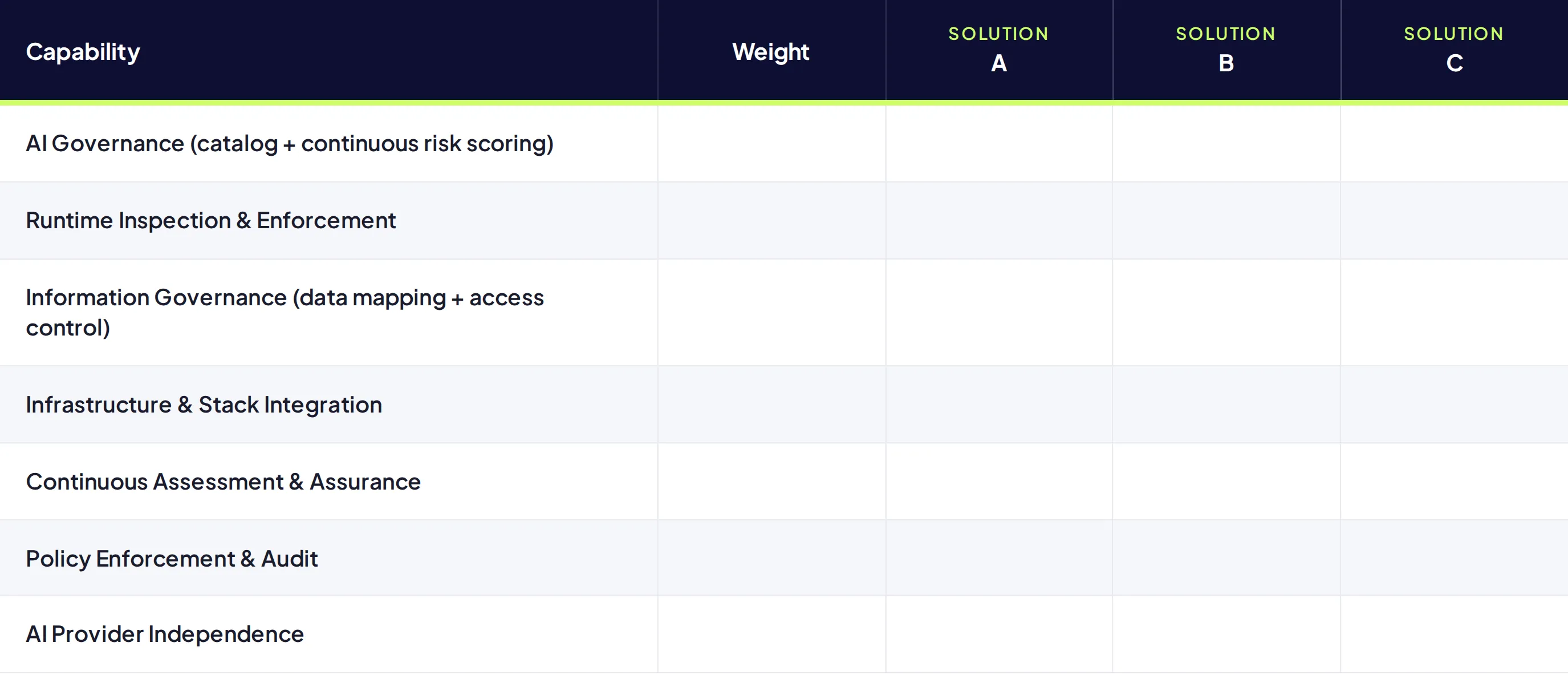
AI Inventory and Cataloging: A continuously updated inventory of every AI model, application, agent, and dataset across the environment. Without complete visibility, the other three layers govern only what they happen to see.
Data Mapping and Lineage: Tracking of data usage across AI systems, with full lineage from source to consumption, so you can prove what data reached which model and why.
Continuous Assessment and Assurance: Application-aware red teaming run continuously rather than once, paired with real-time inspection of production AI. Results should validate systems against NIST AI RMF, MITRE ATLAS, OWASP Top 10 for LLMs, and the EU AI Act, both before and after deployment.
Pre- and Post-Deployment Governance: Automated vetting before an AI system ships, and runtime controls that maintain governance after launch. Governance that ends at deployment is governance in name only.
Policy Enforcement and Compliance: A policy engine that authors rules in natural language and enforces them automatically, with audit trails mapped to regulatory requirements. Enforcement at runtime, not a report someone else has to act on.
AI Provider Independence: Coverage across proprietary models, open-source systems, cloud services, and third-party vendors, without lock-in to a single provider's ecosystem.
Infrastructure and Stack Integration: Native connection to the SIEM, SOAR, SSO, and ticketing systems you already run, so TRiSM strengthens current operations instead of replacing them.
Differentiating Capabilities
All four layers from one control plane: Many tools deliver one or two layers. The differentiator is unified coverage where the layers are connected by default, not integrated after purchase.
Runtime enforcement, not point-in-time review: Acting at the moment of interaction, across browser sessions, API calls, and agent actions, rather than reporting on what already happened.
Risk intelligence at scale: Current risk profiles for the models, services, and agents in your environment, scored automatically rather than assessed by hand.
Enable, don't block: Guiding users toward approved, safer alternatives instead of denying requests outright, so governance accelerates adoption rather than driving shadow AI.
Agentic readiness: Discovering and governing AI agents, MCP servers, and cross-system agentic workflows, where permissions and autonomy create risks static models never did.
What to Ask When Evaluating AI TRiSM Solutions
Use these questions to separate a connected TRiSM platform from a collection of single-layer tools positioned as one.
AI Governance
Does the solution maintain a continuously updated catalog of every AI model, application, agent, and dataset?
Is risk scored automatically and continuously, or assessed manually at intervals?
Can policies be authored in natural language and routed through a single cross-functional approval workflow?
Does governance extend from experimentation through production, or stop at deployment?
Runtime Inspection and Enforcement
Does it inspect every AI interaction in real time: browser sessions, API calls, and agent actions?
What enforcement actions are available: block, allow, restrict, redact, reroute to a safe alternative?
Does it detect prompt injection, content policy violations, and anomalous usage as they happen?
What is the enforcement response time at the point of interaction?
Information Governance
Does discovery cover homegrown applications, public AI services, and embedded SaaS features without deploying agents?
Does it map which users access which AI tools and what data flows through each interaction?
Does it classify sensitive data automatically and enforce access based on data sensitivity and user permissions?
Can it stop PII, PHI, and proprietary data from reaching unauthorized AI services before exposure occurs?
Infrastructure and Integration
Does it connect to existing SIEM, SOAR, SSO, and ticketing systems such as ServiceNow and Jira?
Does adoption require replacing current security infrastructure?
Does it deploy across cloud, hybrid, and on-premises AI environments?
What APIs are available, and are there per-connection fees?
Cross-Layer Coverage
Do the four layers share one inventory and one policy model, or does each tool keep its own?
When a policy changes, does it propagate across layers automatically, or require updating several tools by hand?
Does the vendor deliver each TRiSM capability natively, or assemble it from partner products?
Compliance and Audit
Which frameworks does it map to out of the box: NIST AI RMF, EU AI Act, GDPR, HIPAA, CCPA, SOC 2, ISO 27001, OWASP Top 10 for LLMs?
Does it support sector-specific requirements such as SEC, FINRA, or public-sector mandates?
Is every interaction, approval decision, and enforcement action captured in an audit trail?
Scalability and Future-Proofing
Does it govern AI agents, MCP servers, and multi-agent workflows, or only static models?
Does it keep pace with new regulations and emerging agentic risk?
Does it provide consistent coverage across AWS, Azure, GCP, on-premises, and SaaS from one control plane?
Mistakes to Avoid When Selecting an AI TRiSM Solution
Buying one layer and calling it TRiSM. The most common mistake. A governance catalog or a runtime tool can look complete in a demo while covering a quarter of the framework. Confirm coverage across all four layers before anything else.
Accepting disconnected layers. When the governance platform cannot enforce at runtime and the runtime tool has no view of the AI catalog, each layer operates blind. The gaps between disconnected tools are exactly where incidents happen.
Underestimating the coordination tax. Without a unified system, every policy change means updating multiple tools, retraining multiple teams, and hoping nothing falls through. Fragmentation is a recurring operational cost, not a one-time integration project.
Mistaking point-in-time review for continuous assurance. AI systems, configurations, and permissions change constantly, and agentic systems change their own behavior. A one-time assessment is stale the moment it finishes. Require continuous assessment and runtime enforcement.
Governance that blocks innovation. Controls that default to denial push business units toward unmanaged tools. The result is more shadow AI, not less. Favor an approach that redirects users to safe alternatives and clears approvals in hours, not weeks.
Requiring infrastructure replacement. A solution that demands you rip out existing SIEM, SOAR, SSO, or ticketing systems adds cost and delay. TRiSM coverage should layer onto the stack you already run.
Preparing for Tomorrow's TRiSM Challenges
Agentic and autonomous systems. AI agents act, invoke tools, and interact across systems on their own. They introduce permission, reliability, and oversight challenges static models never posed, and multi-agent systems connected through protocols like MCP compound them. Confirm the solution can govern agentic workflows across all four layers, not only catalog the models behind them.
Embedded and third-party AI risk. AI features keep arriving inside the SaaS applications you already license, frequently defaulting to ON without explicit consent. Covering this requires runtime discovery of AI features within your stack, not vendor questionnaires.
Regulatory expansion. AI regulation is multiplying across jurisdictions: the EU AI Act, state-level rules, and sector-specific requirements in healthcare, financial services, and the public sector. Choose a solution that updates regulatory content continuously and maps activity to new frameworks without major reconfiguration.
Multi-cloud and hybrid reality. AI runs across AWS, Azure, GCP, on-premises systems, and SaaS at the same time. TRiSM coverage should be consistent across all of them from a single control plane, not stitched together one provider at a time.
Interoperability at scale. Effective TRiSM depends on connections to identity, security, and workflow systems across the enterprise. Evaluate not only today's integrations but the vendor's approach to expanding them.
A Practical Framework for Evaluation
Step 1: Define Your Requirements
Before engaging vendors, document your organization's specific needs:
Which TRiSM layers are weakest in your current stack: governance, runtime, information governance, infrastructure.
Which regulations and frameworks you must satisfy.
Which teams will use the platform: security, IT, privacy, compliance.
Which existing systems it must integrate with: SIEM, SOAR, SSO, ticketing.
Your timeline for deployment.
Step 2: Score Mandatory Capabilities
Rate each solution against the capabilities above, layer by layer.
Step 3: Evaluate Differentiators
Decide which differentiating capabilities matter most for your organization:
All four layers connected from one control plane
Runtime enforcement versus point-in-time review
Risk intelligence breadth and refresh rate
Enable-don't-block user experience
Agentic and MCP readiness
Step 4: Validate with a Proof of Concept
Test each finalist against your own environment:
Discovery accuracy across homegrown, public, and embedded AI
Policy authoring, propagation across layers, and real-time enforcement
Integration with your existing systems
Audit and reporting fit for your stakeholders
Step 5: Assess Vendor Viability
Beyond product capabilities, evaluate the vendor:
Whether each TRiSM layer is delivered natively or assembled from partner products
Financial stability and funding
Customer references in your industry
Support model and responsiveness
Roadmap alignment, especially on agentic governance
Independence and risk of acquisition-driven product stagnation
Four Layers. One System. No Seams.
Gartner's AI TRiSM framework exists because the risks AI introduces across the enterprise are real, compounding, and not covered by the tools that came before. The four layers: AI Governance, Runtime Inspection and Enforcement, Information Governance, and Infrastructure and Stack are designed to work as one system.
When they don't, the gaps between them are where incidents happen, where compliance exposure compounds, and where AI adoption stalls.
The evaluation criteria in this guide are designed to separate platforms that deliver all four layers from a single control plane from those that cover one or two layers and position the result as complete coverage. The distinction matters because the coordination tax of stitching disconnected tools together is not a one-time integration cost. It is an ongoing operational burden that grows with every new AI deployment.
Agentic AI adds urgency to this decision. Agents that invoke tools, interact across systems, and make autonomous decisions at runtime create risk categories that static controls and point-in-time assessments cannot address.
The enterprise that governs AI effectively in the next three years will be the one that connected assessment, enforcement, and runtime control into a single system before agentic adoption scaled.
The question is not whether AI TRiSM is necessary. It is whether your implementation delivers all four layers as an integrated system, or leaves the seams between tools for your teams to manage by hand. We put you in control of AI.™
AI TRiSM (Trust, Risk, and Security Management) FAQs
What is AI TRiSM, and why is it a Gartner framework?
AI TRiSM stands for AI Trust, Risk, and Security Management. Gartner introduced it as a framework to help enterprises manage the unique challenges that AI systems introduce across trust, risk, and security - challenges that conventional IT governance and security tooling were not designed to address.
The framework defines four layers: AI Governance, Runtime Inspection and Enforcement, Information Governance, and Infrastructure and Stack. Gartner positions these layers as interdependent: each informs and reinforces the others, and implementing only one or two leaves material gaps.
How is AI TRiSM different from AI governance?
AI governance covers one layer of TRiSM: cataloging AI assets, assessing risk, and defining enforceable policy. It is necessary but not sufficient. TRiSM extends governance to runtime enforcement, stopping threats at the moment of interaction, and adds information governance for data classification and access control, as well as integration with existing infrastructure. An AI governance platform that stops at policy definition cannot enforce that intent at runtime.
That gap is where TRiSM, as a complete framework, earns its place.
Can we implement AI TRiSM incrementally, starting with the layers where our gaps are worst?
Yes, and most enterprises do. The practical starting point is discovery and governance. You cannot enforce policy over AI you have not inventoried. From there, runtime enforcement and information governance add the operational controls that translate governance intent into outcomes. The risk of an incremental approach is treating each layer as a standalone tool purchase.
When layers share a common inventory and policy model, each one strengthens the others. When they are disconnected, the coordination cost compounds. The evaluation criteria in this guide are designed to help you identify whether a platform can scale across all four layers or only the one you need today.
What does AI TRiSM coverage look like for agentic AI systems?
Agentic systems require TRiSM coverage across all four layers, with additional complexity. AI governance must catalog agents, their tool dependencies, and their permission structures, not just the models they run on. Runtime inspection must extend to agent actions: tool invocations, cross-system interactions, and autonomous decisions made in real time.
Information governance must enforce data access boundaries that agents respect at runtime, not only at configuration. Infrastructure integration must account for protocols such as MCP and multi-agent orchestration patterns that static controls were not designed to govern. Any TRiSM solution that covers agents only at the catalog level does not provide agentic coverage.
How does AI TRiSM map to the EU AI Act, NIST AI RMF, and other regulatory frameworks?
The four TRiSM layers map closely to the obligations these frameworks impose. AI governance covers risk classification and documentation - requirements central to both the EU AI Act and NIST AI RMF. Runtime enforcement provides the continuous operational controls that distinguish compliant AI systems from compliant-on-paper ones.
Information governance addresses the data protection and access requirements imposed by GDPR, HIPAA, and CCPA on AI processing. Infrastructure integration connects TRiSM to the audit and reporting systems that regulators expect to see. A connected TRiSM platform generates compliance evidence as a byproduct of normal operation rather than as a separate documentation exercise.
LET’s COLLABORATE
See how Singulr puts you in control of AI
In your personalized 30-minute demo, you'll see:
Complete visibility across all three AI vectors in your environment, including agents and embedded SaaS AI
Singulr Pulse™ intelligence and the live risk signals that feed your control plane
Continuous red teaming, identifying control gaps and vulnerabilities in real time
Singulr Runtime Control™ enforcing governance intent without slowing innovation